Door Supervisor vs Security Guard: What's the Difference and Which Career Is Right for You?
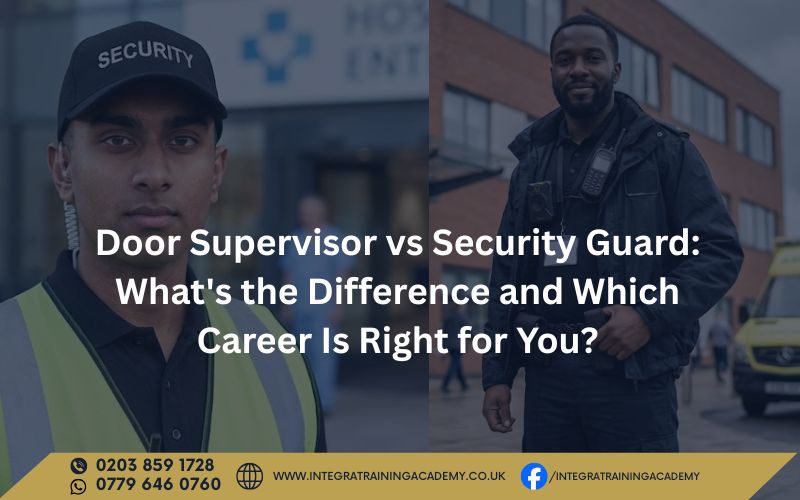
If you're exploring a career in the UK security industry, you've probably come across two roles that sound similar: door supervisor and security guard. While both professionals help keep people and properties safe, they work in different environments, handle distinct responsibilities, and require different qualifications. Understanding these differences is crucial if you're deciding which path suits your skills, interests, and career goals.
This guide breaks down what each role involves, highlights the key distinctions, and helps you determine which security career might be right for you.
What Is a Door Supervisor?
A door supervisor, sometimes called a doorman or doorwoman, is a licensed security professional who works at the entrances and exits of licensed premises. Their primary responsibility is controlling access to venues—deciding who enters and who doesn't.
Door supervisors typically work in:
- Pubs and bars
- Nightclubs and dance venues
- Music festivals and outdoor events
- Concert halls and theatres
- Licensed restaurants and hotels
- Private members' clubs
- Entertainment complexes
- Sports venues
Key responsibilities include:
- Checking age identification (ID) to prevent under-age access
- Monitoring crowds and managing queue flow
- De-escalating conflicts and confrontations
- Ejecting individuals who are intoxicated, aggressive, or disruptive
- Searching people for weapons or prohibited items
- Communicating with venue staff about security concerns
- Reporting incidents and maintaining detailed records
- Assisting emergency services when needed
- Providing customer service while maintaining safety
Door supervisors spend much of their shift interacting directly with the public. They're often the first point of contact for venue visitors, so customer service skills are as important as security expertise.
What Is a Security Guard?
A security guard is a licensed security professional employed to protect people, property, and assets. Security guards work across a much broader range of environments and perform more general protective duties.
Security guards typically work in:
- Office buildings and corporate headquarters
- Shopping centres and retail stores
- Warehouses and distribution centres
- Construction sites
- Hospitals and healthcare facilities
- Banks and financial institutions
- Schools and universities
- Residential developments
- Car parks and transportation facilities
- Manufacturing facilities
Key responsibilities include:
- Patrolling premises on foot or vehicle
- Monitoring CCTV systems and alarm systems
- Checking credentials and managing access control
- Responding to alarms and security breaches
- Conducting bag checks and security screening
- Reporting suspicious activity to managers and police
- Writing incident reports and maintaining logs
- Assisting with emergency procedures
- Protecting assets and preventing theft
- Providing a visible security presence
Security guards often work in static positions (standing guard at an entrance) or mobile patrols (walking around the premises). Their role is broader and less focused on conflict management than door supervisors.
Door Supervisor vs Security Guard: Key Differences
Understanding the specific differences between these roles will help you choose the right career path.
| Feature |
Door Supervisor |
Security Guard |
| Primary Focus |
Access control and conflict management at licensed premises |
General protection of people, property, and assets |
| Main Work Environment |
Licensed venues (pubs, clubs, festivals, restaurants) |
Office buildings, retail, construction, warehouses, healthcare |
| Public Interaction |
High – constantly engaging with venue visitors |
Medium – varies by location; some roles involve limited interaction |
| Conflict Management |
Extensive – regularly de-escalates aggressive situations |
Moderate – deals with confrontation less frequently |
| Physical Intervention |
Common – may need to physically remove intoxicated or violent individuals |
Less frequent – primarily preventative rather than reactive |
| Customer Service Element |
Very high – must balance security with hospitality |
Lower – security is the priority |
| ID Checking |
Core responsibility |
Not typically required |
| Access Control |
Selective – deciding who enters based on venue policy |
Standard – checking credentials and permits |
| Working Hours |
Evening and night shifts common; weekends and holidays typical |
Variable; day, evening, and night shifts depending on location |
| Required Licence |
SIA Door Supervisor Licence (mandatory) |
SIA Security Guard Licence (mandatory) |
| Training Focus |
Conflict management, de-escalation, customer service |
General security procedures, CCTV monitoring, access control |
| Career Progression |
Venue management, head of security, security consulting |
Mobile patrol supervisor, control room operator, site manager |
Similarities Between Both Roles
Despite their differences, door supervisors and security guards share important common ground:
- Crime prevention – Both roles deter criminal activity through their presence and vigilance
- Protecting people – Safety of the public and staff is a priority for both
- Asset protection – Both help prevent theft and damage to property
- Incident reporting – Both must document what they observe and respond to incidents professionally
- Emergency response – Both are trained to assist during emergencies and evacuations
- Customer service – Both interact with members of the public and represent their employer professionally
- Professional conduct – Both must maintain high standards of behaviour and appearance
- Security awareness – Both spot suspicious activity and take preventative action
- Communication – Both report concerns to management and emergency services when necessary
- Legal responsibility – Both must understand relevant laws including the Private Security Industry Act
Skills Needed to Succeed in Security Roles
Both door supervisors and security guards need a strong foundation of transferable skills. Here's what employers look for:
| Skill |
Why It Matters |
Essential For |
| Communication |
Clearly explaining security decisions to the public and colleagues |
Both roles equally |
| Observation |
Spotting suspicious behaviour, injuries, intoxication, or hazards |
Both roles equally |
| Decision-Making |
Quickly assessing situations and responding appropriately |
Door Supervisors (higher pressure) |
| Conflict Resolution |
De-escalating tense situations before they become violent |
Door Supervisors (critical) |
| Physical Fitness |
Managing physically demanding work and intervening when necessary |
Both roles; more intensive for Door Supervisors |
| Situational Awareness |
Understanding your environment and anticipating problems |
Both roles equally |
| Teamwork |
Collaborating with colleagues, management, and emergency services |
Both roles equally |
| Professionalism |
Maintaining composure, appearance, and integrity |
Both roles equally |
| Customer Service |
Handling complaints and providing friendly, helpful responses |
Door Supervisors (higher priority) |
| Problem-Solving |
Addressing security issues creatively and efficiently |
Both roles equally |
Which Role Is Better?
Neither role is universally "better"—the right choice depends on your personal preferences, skills, and career aspirations.
Choose door supervisor if you:
- Enjoy high levels of public interaction
- Are comfortable with confrontation and conflict management
- Prefer evening and night-time working hours
- Like working in fast-paced, social environments
- Are confident handling intoxicated or aggressive people
- Want to build skills in de-escalation and communication
- Thrive in venues with music, events, and entertainment
Choose security guard if you:
- Prefer quieter, more routine work environments
- Want more flexibility in shift patterns
- Prefer working in corporate, retail, or industrial settings
- Value a broader range of security responsibilities
- Like the variety that comes with different site locations
- Want to focus on prevention rather than confrontation
- Prefer working during day shifts or varying hours
Career progression matters too. Door supervisors who excel can move into head of security roles at large venues or event management. Security guards can progress into control room supervision, mobile patrol management, or site security management.
Career Opportunities in the UK Security Industry
The UK security industry is growing, and both paths offer genuine career development.
Door Supervisor opportunities exist in:
- Entertainment and hospitality sectors
- Event management and festival security
- Private members' clubs and high-end venues
- Airport and transport terminal hospitality areas
- Luxury hotel security
- VIP protection and corporate entertainment
Security Guard opportunities exist in:
- Retail and shopping centres
- Construction and property development
- Manufacturing and warehousing
- Corporate office security
- Healthcare and hospital security
- Banking and financial services
- Educational institutions
- Residential and property management
- Utilities and infrastructure protection
Both sectors offer opportunities for career advancement, specialisation, and salary growth. Many security professionals start in entry-level roles and progress into management, training, or consulting positions.
Which SIA Licence Do You Need?
The Security Industry Authority (SIA) regulates the private security industry in the UK. To work in either role professionally, you must hold the correct licence.
SIA Door Supervisor Licence is required if you work:
- At the entrance or exit of licensed premises
- At pubs, bars, and nightclubs
- At restaurants and hotels serving alcohol
- At events with alcohol sales
- Checking ID and managing access to licensed venues
SIA Security Guard Licence is required for most other security roles, including:
- Office and retail security
- Warehouse and construction site protection
- CCTV monitoring
- Mobile patrol work
- Static guarding at non-licensed premises
Both licences require passing an SIA assessment and meeting specific eligibility criteria. If you're planning to work in licensed premises, pubs, clubs, festivals or entertainment venues, it's worth learning more about the relevant training and licence requirements.
Training programmes typically cover conflict management, customer service, health and safety, and legal responsibilities specific to each role.
Frequently asked questions
The main difference is focus and environment. Door supervisors work at the entrances of licensed premises, controlling access and managing conflicts in social venues. Security guards work across broader locations (offices, retail, construction, warehouses) with more general protection duties. Door supervisors deal more with intoxicated or aggressive people; security guards focus more on prevention and asset protection.
You need an SIA licence to work as a licensed security professional in the UK. Door Supervisors need the Door Supervisor Licence; most other security roles require the Security Guard Licence. Some specialised roles (like close protection) require different licences. You cannot legally work as either without the correct SIA licence.
Yes. A door supervisor can transition into security guard work. However, holding a Door Supervisor Licence doesn't automatically qualify you as a Security Guard. Many professionals hold both licences to increase job opportunities. You would need to complete the Security Guard training and assessment if you want to work officially in security guard roles.
Security guard roles are more diverse and available across more sectors and locations. However, door supervisor roles in hospitality and events are plentiful in major cities and entertainment areas. Both sectors are growing, but security guard positions offer broader career flexibility due to the range of work environments.
Yes. Both door supervisors and security guards must hold valid SIA licences to work legally in the UK private security industry. Working without the correct licence is illegal and carries penalties. Training providers can help you understand which licence you need for your chosen role.
Door supervisors have significantly more customer interaction. They're constantly checking IDs, managing queues, and engaging with venue visitors. Security guards interact with the public less frequently; their focus is on observation, patrolling, and monitoring systems. If you enjoy people-facing work, door supervision is the better choice.
Security guards work in diverse locations including office buildings, shopping centres, retail stores, warehouses, construction sites, hospitals, banks, schools, car parks, and residential developments. This variety makes security guard roles flexible and widely available across the UK.
Switching is possible but requires obtaining the appropriate licence for your new role. Both require similar core knowledge, but specific training differs. Many professionals start in one role and transition to the other to gain experience or seek new challenges. The skills from one role transfer well to the other, making a career switch relatively straightforward.




Leave a comment